

MONTHLY MARKET UPDATE
2 December, 2025
Author: Jesmar Halliday, CFA
Equity markets worldwide produced a varied set of equity returns, with pronounced differences between regions. While several major Asian exchanges suffered significant losses, European and US markets generally managed to hold steady, achieving modest gains. Investors appeared increasingly inclined to shift away from economies exposed to currency instability, softer export activity [take China], and volatility in technology-linked sectors which are factors that weighed most heavily on parts of Asia [Including the Taiwanese Stock market]. The deepest setbacks were concentrated in North Asian markets with the Nikkei 225 and the CSI 300 dropped by around 4 per cent and 2.4 per cent respectively. These downturns were shaped by subdued global demand signals, persistent concerns over elevated valuations in tech-heavy industries, and ongoing sensitivity to fluctuations in external trade conditions.
In contrast, Europe offered a steadier picture. European equity indices across the different regions and market capitalisation registered slight but consistent increases. The region’s relative calm seemed to stem from more favourable inflation developments, a tilt toward defensive sectors, and an improving sense of relative value. Across the Atlantic, US equities also advanced, albeit in a restrained manner. Incremental gains across major benchmarks suggested that markets are delicately balancing solid labour-market data with uncertainty surrounding the future trajectory of Federal Reserve policy.
Several smaller and developing European markets outshone their larger counterparts, bolstered by stronger domestic fundamentals, lighter regulatory constraints, and more compelling valuation starting points. This was particularly apparent in Central and Eastern Europe, where investor sentiment proved more durable than in Europe’s major export-driven economies. This is exemplified by the performance of the FTSE MIB in Italy as it rose by 1.6 per cent and the Spanish IBEX 35 which returned 2.6 per cent for the month of November. Moreso, equity indices in Romania, Budapest and Latvia returned 3 per cent, 2 per cent and 1.6 per cent respectively. Performance across emerging markets was similarly varied, spanning moderate progress in Southeast and South Asia and far stronger gains in Latin America. Brazil emerged as a clear outperformer, supported by improving macroeconomic momentum, a firmer currency backdrop, and renewed investor interest in cyclical sectors with a November return of around 6.4 per cent.
Markets with pronounced exposure to commodities, especially those in Latin America and select Asian economies delivered the most impressive November gains. These improvements were underpinned by more favourable terms of trade and healthier external positions, both of which contributed to a resurgence in investor enthusiasm for economies tied closely to natural resources and domestic recovery dynamics.
Fixed-income markets experienced a generally subdued month, with performance differing noticeably across regions and maturities. European sovereign bonds with longer durations came under soft but persistent pressure as investors reacted to lingering uncertainty surrounding the inflation outlook and guarded communication from the ECB. Yields along the far end of the curve drifted gradually higher, keeping returns muted. Shorter-dated bonds, however, fared somewhat better, benefitting from market expectations that monetary policy would remain unchanged for a longer period, resulting in marginally positive contributions over the month. In the United Kingdom, gilts produced steadier returns across the curve. More settled inflation expectations and pockets of improvement in domestic economic data helped temper volatility, giving investors greater confidence in the Bank of England’s cautious stance. This sense of stability also reflected a broader acceptance of the government’s fiscal direction following the multiple economic initiatives announced by the UK Chancellor Rachel Reeves in her Budget speech at the tail end of November.
Across the Atlantic, US Treasuries outshone most of their developed-market peers, particularly in intermediate and longer maturities. Markets responded positively to the Federal Reserve’s communication, interpreting recent messaging as consistent with a gradual easing profile expected to take shape in 2026. As yields moved lower, total returns outpaced those of other major sovereign markets. Meanwhile, emerging-market sovereign bonds generally delivered stable-to-improving results, supported by lower global yields and a pickup in risk appetite. Markets with firm macroeconomic underpinnings with India being a prominent example attracted continued inflows and enjoyed support from a favourable domestic inflation backdrop.
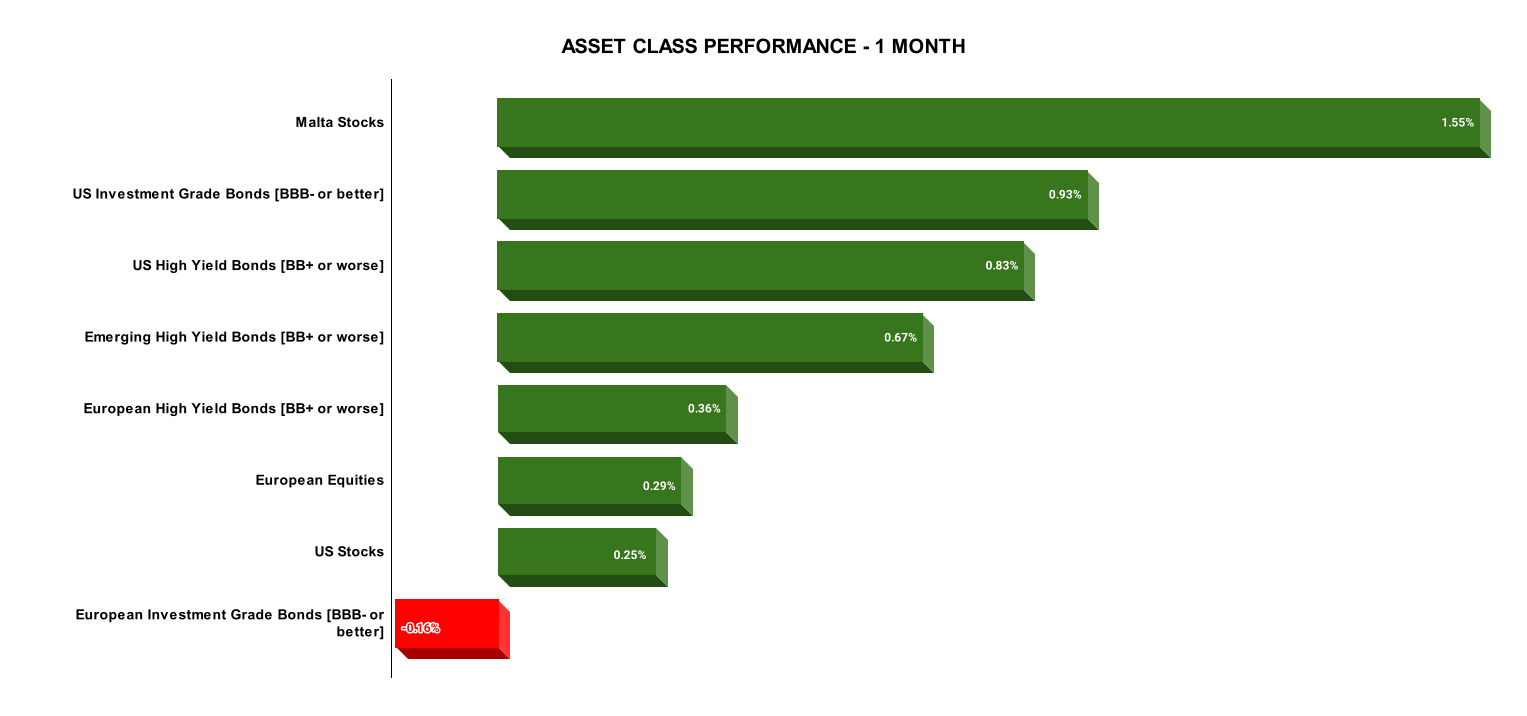
Corporate credit posted a modestly constructive month, with gains recorded across both investment-grade and high-yield segments. The investment-grade space benefitted from calmer rate conditions and resilient corporate fundamentals, particularly in the United States (November returns +0.7 per cent). Euro-area investment-grade bonds, by contrast, saw more restrained performance (November returns -0.2 per cent), reflecting softer economic indicators and a cloudier earnings outlook. High-yield debt produced healthier gains worldwide as investors continued to pursue income-generating assets. The strongest momentum appeared in US and emerging-market high yield, aided by firmer commodity conditions and stabilising default expectations. European high yield trailed behind with a flat performance due to sluggish regional growth and uneven sector-specific performance. With return dispersion widening across issuers and regions, the market increasingly favoured companies with robust cash flows, signalling that credit selection will become ever more crucial as the policy cycle nears a turning point in 2026.
Throughout November, the ECB reinforced the message that its current policy stance remains appropriately calibrated. Interest rates were left unchanged at the October meeting1, with the deposit rate steady at 2 per cent which is judged sufficient to maintain economic stability while absorbing external shocks. However, discussions within the Governing Council revealed diverging views with some policymakers arguing that the easing phase may have run its course, while others cautioning that policy flexibility must be preserved should the disinflation trend falter. These internal tensions left markets uncertain about the trajectory of future decisions, with only slim probabilities assigned to further rate cuts in 2026. The ECB’s latest Financial Stability Review added further caution, highlighting structural vulnerabilities, including overvalued segments of the equity market particularly in technology and AI and increasing interdependence between banks and non-bank financial institutions.
In the United States, the Federal Reserve entered a period of heightened ambiguity. Policymakers remained split over the economic outlook with some emphasising the resilience of growth and labour demand, while others pointing to signs of cooling activity and external risks. This divergence prompted a surge in hedging activity as investors increased exposure to swaptions and overnight-rate derivatives to manage shifting expectations around policy outcomes.
The Bank of Japan faced its own set of challenges as intensifying price pressures revived debate around monetary normalisation. Tokyo’s consumer prices rose by 2.8 per cent year-on-year in November which is a figure well above the Bank of Japan’s inflation target. Although service-sector price gains remained moderate, basic goods experienced pronounced inflation, particularly food items. Labour-market tightness further fuelled concerns. BoJ board member Asahi Noguchi emphasised the need for a gradual tightening path, warning that overly accommodative real interest rates risk entrenching inflationary pressures and further undermining the yen.
Late in the month, global growth projections were revised slightly higher, offering a measured sense of optimism for 2025–2027. The upgrade was driven in part by a firmer-than-anticipated rebound in mainland China. Nevertheless, the broader industrial backdrop remains fragile. Manufacturing sectors across major economies continue to experience strain, weighed down by softer US demand and tariff-related disruptions. Industrial activity in the euro area is largely stagnating with Germany’s engineering sector weakening, and France and Italy have seen mixed-to-negative readings. International trade flows remain challenged by evolving protectionist strategies, particularly originating from the United States, which continue to reshape global supply chains and reduce export momentum across manufacturing hubs.
Important Information:
This article was prepared by Jesmar Halliday, CFA, Portfolio Manager at MZ Investments and is intended solely for information purposes. The contents of this article should not be construed as investment, legal or tax advice, or as a recommendation to buy, sell, or hold any securities, investment strategy or market sector. The information contained in this article was obtained from sources believed to be reliable and has not been verified independently. MZ Investments, its directors and employees give no warranties of any kind, expressed or implied, with regard to the accuracy, correctness or completeness of this article and accepts no responsibility or liability for any loss or damages arising out of the use of all or any part of this article. MZ Investments is under no obligation to update or keep current the information contained therein. All investments involve risk. The value of investments may go down as well as up and investors may not get back the amount originally invested. Investors are urged to seek professional advice before making investment decisions.
M.Z. Investment Services Limited (MZISL) of 63, MZ House, St Rita Street Rabat, Malta RBT 1523, is regulated by the MFSA and licensed to conduct investment services business in terms of the Investment Services Act Cap. 370 of the Laws of Malta. MZISL is a member of the Malta Stock Exchange and enrolled under the Insurance Distribution Act, Cap. 487 of the Laws of Malta, as a Tied Insurance Intermediary for MAPFRE MSV Life p.l.c. (MMSV). MMSV (C-15722) is authorised by the MFSA to carry on long-term business under the Insurance Business Act, Cap 403 of the Laws of Malta. MMSV is regulated by the MFSA.