

MONTHLY MARKET UPDATE
9 January, 2025
Author: Jesmar Halliday, CFA
Equity markets over the period displayed a pronounced regional divergence, with Europe and emerging markets assuming clear leadership. Performance across continental Europe was firmly positive and broadly distributed, signalling a notable shift in investor confidence. Strong advances were recorded across a range of markets, particularly in southern and eastern Europe, suggesting that investors increasingly viewed the region as having moved beyond the most acute phase of inflationary and monetary tightening pressures. In contrast, US equities struggled to generate meaningful momentum. Returns across major indices were largely subdued, with smaller capitalisation stocks and technology-heavy segments drifting modestly lower. The narrow gains posted by broader benchmarks reflected a more cautious stance towards elevated valuations and ongoing sensitivity to interest-rate expectations, as investors appeared reluctant to extend risk exposure late in the year.
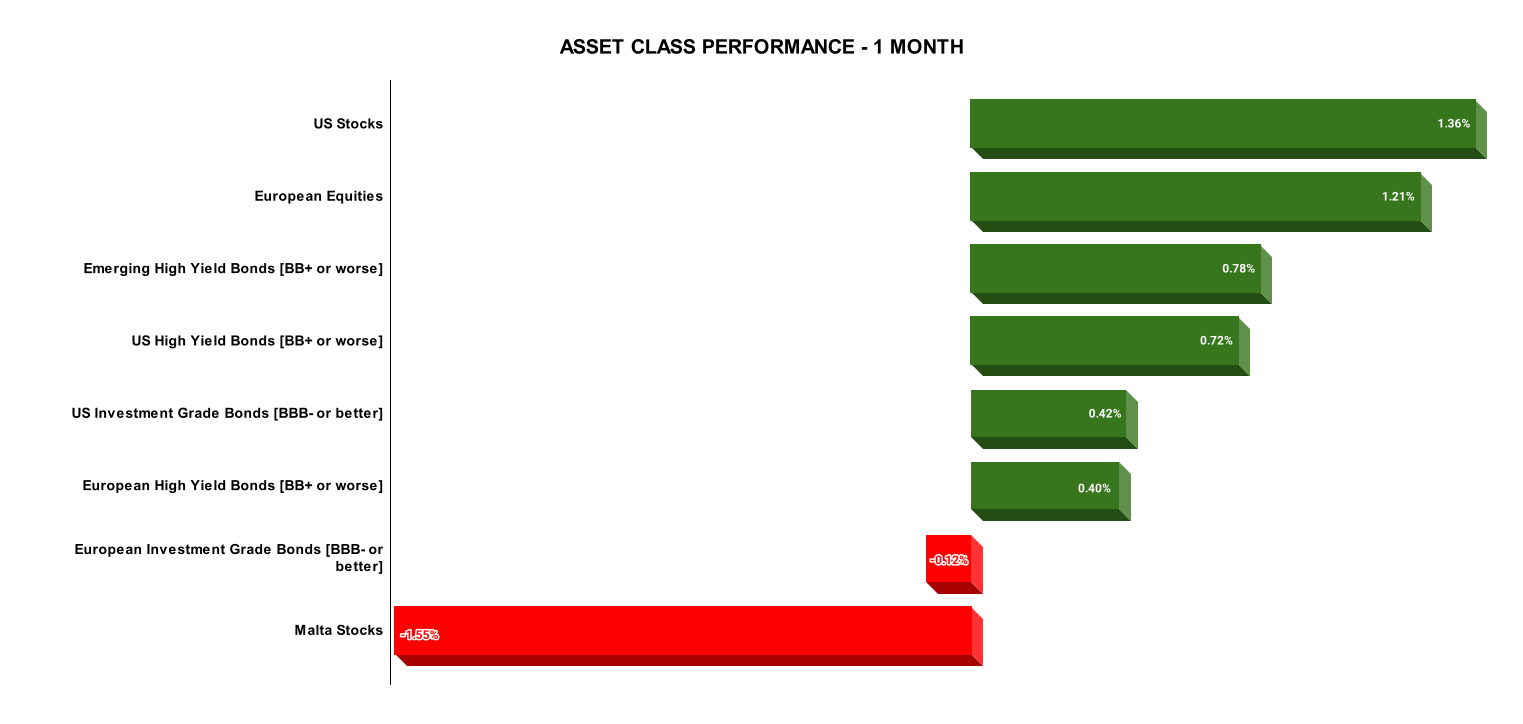
European market participation was notably broad-based with large-, mid- and small-cap indices all delivering comparable positive returns, highlighting improving conviction rather than a rally confined to defensive or index-heavy names. This breadth differentiated Europe from the US, where performance remained narrower and more selective. Further strength was evident in peripheral and less liquid European markets, which outperformed core regions by a considerable margin. While core markets delivered respectable gains, stronger upside was concentrated in countries more exposed to cyclical recovery dynamics. This dispersion points to a late-year reallocation towards higher-beta exposures as concerns around recession risk continued to ease.
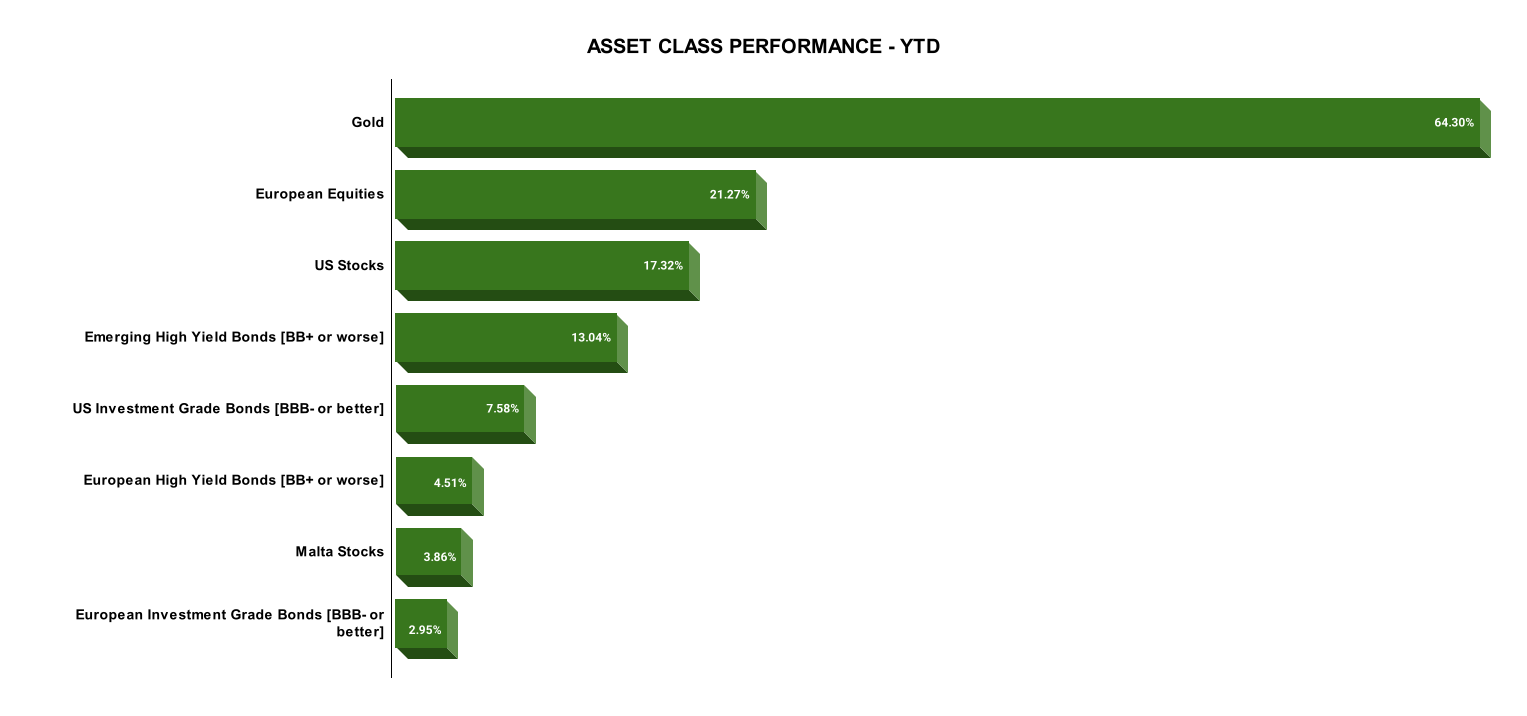
Asian equity markets delivered a mixed but generally constructive outcome. Technology-oriented markets stood out, supported by sustained optimism around semiconductors and global technology demand, while broader regional performance remained more muted. China posted moderate gains, indicating stabilisation rather than a decisive improvement in sentiment. Emerging markets as a whole were among the strongest performers during the period. Gains across Latin America, parts of Asia and Africa reflected a selective return of risk appetite, underpinned by relatively attractive valuations and improving macro fundamentals. UK equities also posted positive returns, supported by year-end flows and income-oriented sectors, though performance lagged several European peers amid ongoing concerns surrounding domestic growth and longer-term structural challenges.
Fixed income markets faced a challenging backdrop, particularly across developed market government bonds. Weakness was most evident at the long end of yield curves, where rising yields translated into meaningful negative total returns. Both US Treasuries and euro area sovereign bonds experienced pronounced pressure in longer maturities, reflecting investor caution around the timing of future monetary easing and persistent concerns around inflation dynamics and bond supply.
Shorter-dated government bonds proved considerably more resilient. Performance across front-end maturities was relatively stable, and in some cases marginally positive, indicating that markets broadly viewed policy rates as being close to their peak. The divergence between short and long maturities highlighted curve steepening pressures rather than indiscriminate selling across duration. Investment-grade credit markets delivered subdued but defensive outcomes. Returns hovered close to flat, as higher underlying yields weighed on performance despite credit spreads remaining relatively well anchored. This stability suggests that corporate balance sheets and default expectations continued to provide support, even in a rising yield environment.
Sterling-denominated bonds emerged as relative outperformers within developed markets. UK government bonds posted modest gains across several maturities, while sterling investment-grade corporate bonds delivered more robust positive returns. This resilience reflected a combination of currency dynamics and a perception that UK monetary policy expectations were comparatively stable towards the end of the year. Emerging market investment-grade debt recorded mild declines, largely driven by global rate movements rather than any deterioration in credit quality. Higher developed market yields offset improvements in emerging market fundamentals, resulting in modestly negative returns overall. High yield credit stood out as the strongest-performing segment within fixed income. Returns were consistently positive across regions, supported by carry, stable default expectations and sustained investor demand. Emerging market high yield was particularly strong, reflecting a continued willingness among investors to selectively embrace credit risk in search of yield.
Central bank communication towards year-end adopted a distinctly cautious and measured tone. In Europe, policymakers signalled that monetary policy had entered a consolidation phase following an extended tightening cycle. While inflation continued to moderate, officials remained wary of declaring victory too soon, emphasising flexibility and data dependence amid softening growth conditions across several member states. In the United States, the Federal Reserve reinforced the message that policy rates were likely at or near their peak, while pushing back against expectations of rapid easing. Although markets increasingly priced in rate cuts for the year ahead, Fed officials stressed that any adjustment would depend on sustained progress in inflation and labour market rebalancing, maintaining a disciplined and patient stance. Japan’s central bank continued its carefully managed shift away from ultra-accommodative policy. Messaging during the period reflected an emphasis on gradualism, balancing encouraging developments in wages and inflation against the risks of disrupting currency and bond markets. The preference remained for incremental change supported by clear communication. The Bank of England maintained a similarly cautious posture, navigating persistent domestic inflation pressures alongside a fragile growth environment. Policymakers resisted signalling early easing, instead reiterating the need for further evidence of disinflation, particularly within wages and services. In contrast, several emerging market central banks adopted a more accommodative stance, selectively easing policy as inflation pressures receded and currency conditions stabilised.
Geopolitical developments continued to shape the global backdrop. Ongoing tensions in Eastern Europe and the Middle East kept energy security and trade routes under scrutiny, contributing to episodic volatility across commodity markets. Although financial markets appeared increasingly accustomed to geopolitical headlines, the associated risk premium remained embedded in asset pricing. Trade and industrial policy remained a prominent theme, particularly in relation to the United States’ assertive approach towards strategic industries and tariffs. Rhetoric around supply-chain resilience and economic security reinforced concerns around global fragmentation, even as corporates adapted by diversifying production and investment footprints. From a macroeconomic standpoint, the global economy closed the year displaying uneven resilience. The US continued to demonstrate underlying strength, supported by consumption and investment, while Europe faced softer growth and industrial headwinds. China showed tentative signs of stabilisation, supported by targeted policy measures, though confidence remained fragile and recovery uneven. Emerging markets entered the final weeks of the year on a relatively firmer footing, benefiting from easing inflation, improved external balances and renewed capital inflows. Nonetheless, structural vulnerabilities persisted in certain regions. Overall, the closing phase of 2025 reflected an adjustment towards a new global equilibrium characterised by tighter financial conditions, elevated geopolitical uncertainty and a gradual recalibration of growth expectations.
LOOKING AHEAD TO 2026
Financial markets are likely to be shaped by a combination of monetary policy decisions, economic resilience, geopolitical developments and structural shifts across industries. While some of the dominant themes from recent years are expected to persist, their influence is likely to evolve as markets transition into a new phase of the cycle. A central factor will be the direction and timing of monetary policy easing across major economies. Investors will be closely watching whether central banks begin cutting interest rates in a measured and coordinated manner, or whether stubborn inflation forces policymakers to maintain restrictive settings for longer. The pace of disinflation, developments in wage growth and the resilience of labour markets will be critical in determining whether lower rates support risk assets or instead signal a sharper economic slowdown.
Economic growth dynamics will also play a key role. The United States enters 2026 with momentum that has repeatedly surprised on the upside, but questions remain around how long consumption and investment can remain robust under tighter financial conditions. Europe faces a more fragile outlook, with industrial weakness and fiscal constraints potentially limiting upside, while China’s ability to engineer a durable recovery will be crucial for global trade, commodities and emerging markets. Divergence in growth outcomes could lead to increased dispersion across regions and asset classes. Geopolitical risks are expected to remain a persistent source of uncertainty. Ongoing conflicts, shifting alliances and the risk of escalation in sensitive regions may continue to influence energy markets, supply chains and investor sentiment. In parallel, trade and industrial policy, particularly between major economic blocs, is likely to remain a focal point, with protectionist measures and strategic competition shaping cross-border investment and corporate decision-making.
Fiscal policy and government debt sustainability may come further into focus in 2026. Elevated public debt levels, increased issuance of government bonds and political pressures ahead of elections in several countries could affect bond yields and currency markets. Investors may become more sensitive to fiscal credibility, particularly in economies where debt servicing costs rise materially as rates remain above pre-pandemic norms. Technological and structural trends will continue to influence market leadership. The rapid development and adoption of artificial intelligence, automation and digital infrastructure could support productivity gains and corporate earnings but may also exacerbate valuation dispersion between winners and laggards. At the same time, the transition towards renewable energy and climate-related investment is likely to remain uneven, influenced by policy support, capital availability and geopolitical considerations.
Important Information:
This article was prepared by Jesmar Halliday, CFA, Portfolio Manager at MZ Investments and is intended solely for information purposes. The contents of this article should not be construed as investment, legal or tax advice, or as a recommendation to buy, sell, or hold any securities, investment strategy or market sector. The information contained in this article was obtained from sources believed to be reliable and has not been verified independently. MZ Investments, its directors and employees give no warranties of any kind, expressed or implied, with regard to the accuracy, correctness or completeness of this article and accepts no responsibility or liability for any loss or damages arising out of the use of all or any part of this article. MZ Investments is under no obligation to update or keep current the information contained therein. All investments involve risk. The value of investments may go down as well as up and investors may not get back the amount originally invested. Investors are urged to seek professional advice before making investment decisions.
M.Z. Investment Services Limited (MZISL) of 63, MZ House, St Rita Street Rabat, Malta RBT 1523, is regulated by the MFSA and licensed to conduct investment services business in terms of the Investment Services Act Cap. 370 of the Laws of Malta. MZISL is a member of the Malta Stock Exchange and enrolled under the Insurance Distribution Act, Cap. 487 of the Laws of Malta, as a Tied Insurance Intermediary for MAPFRE MSV Life p.l.c. (MMSV). MMSV (C-15722) is authorised by the MFSA to carry on long-term business under the Insurance Business Act, Cap 403 of the Laws of Malta. MMSV is regulated by the MFSA.