

MONTHLY MARKET UPDATE
3 February, 2025
Author: Jesmar Halliday, CFA
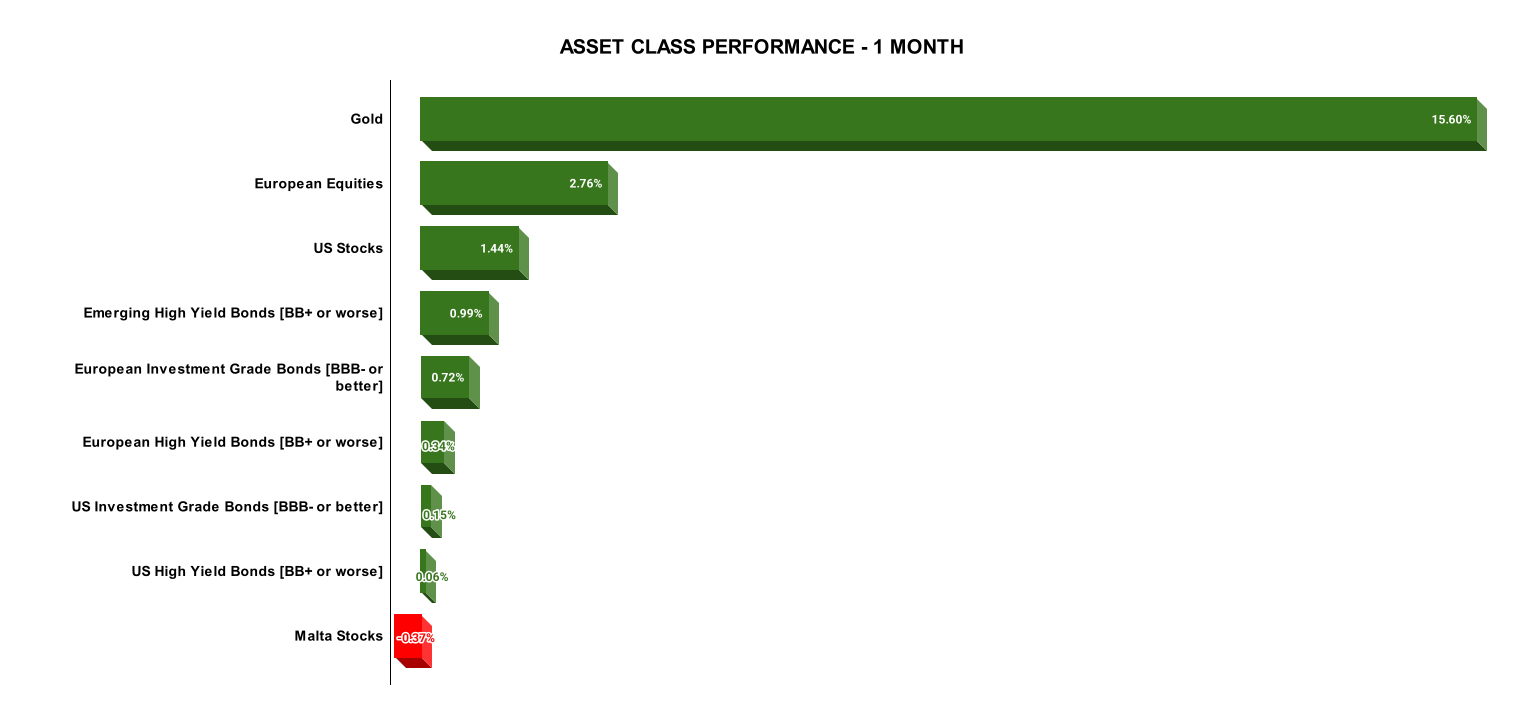
Equity market performance over the period was characterised by a clear resurgence in risk appetite, most visibly expressed through the strong outperformance of emerging markets relative to developed peers. Gains were particularly pronounced across Central and Eastern Europe and Latin America, where Hungary advanced by 16.03%, Brazil rose 12.56%, and Romania gained 11.26% in local currency terms. These substantial returns reflected renewed investor willingness to allocate towards higher-beta regions, supported by improving global liquidity conditions and a softer US dollar, which declined by 1.35% over the month. European equities also delivered encouraging results, with performance breadth extending beyond core markets into smaller and peripheral economies. Southern European markets were notable contributors, as Spain’s IBEX 35 rose 3.69%, Portugal PSI 20 gained 4.82%, and Italy FTSE-MIB advanced 1.62%. Larger regional benchmarks followed suit, with the Euro Stoxx 50 and the broader European index rising by 2.79% and 2.88% respectively, signalling a modest improvement in regional confidence as the year began.
Asian equity markets presented a more nuanced picture. North Asian markets performed strongly, underpinned by optimism surrounding technology exports and global manufacturing activity. Taiwan recorded a robust 10.76% increase, while Japan’s Nikkei 225 climbed 5.93%. In contrast, performance across parts of emerging Asia lagged, with India declining 3.02% and Indonesia falling 3.58%, underscoring continued selectivity among investors and lingering concerns around domestic growth dynamics in certain economies. In the UK, equity returns were positive but comparatively restrained relative to continental Europe. The FTSE 100 gained 2.99%, while the more domestically oriented FTSE 250 outperformed with a 3.68% increase. This divergence pointed to improving sentiment towards UK mid-caps, reflecting expectations of stabilising domestic conditions and a potential easing in financial pressures.
US equity markets advanced more modestly, though underlying performance varied by market capitalisation. Large-cap indices posted measured gains, with the S&P 500 rising 1.44%, the Dow Jones Industrial Average up 1.80%, and the NASDAQ increasing 0.97%. Smaller companies were more resilient, as the Russell 2000 climbed 5.39% and the S&P MidCap 400 gained 4.05%, suggesting a rotation towards more cyclical and value-oriented segments of the market.
Fixed income markets entered the year on a relatively steady footing, though performance varied meaningfully across regions and credit quality. Euro-denominated assets were clear beneficiaries of the improving inflation narrative, with government bonds in the euro area delivering the strongest returns. Longer-dated maturities led the advance, as bonds in the 10–15 year segment rose by approximately 0.97%, while securities beyond 15 years gained 0.96%. This reflected a growing willingness among investors to reintroduce duration into portfolios as confidence increased that price pressures are gradually receding.
In contrast, US government bonds produced weaker outcomes, hampered by continued uncertainty surrounding the pace and timing of any future Federal Reserve policy adjustment. Shorter-dated Treasuries recorded modest declines, with 5–7 year maturities falling 0.06% and 7–10 year bonds down 0.21%. Longer-dated US Treasuries were largely unchanged over the period, with the 15-year-plus segment edging lower by 0.03%, underscoring a cautious approach towards long-term rate exposure. UK gilts delivered positive, albeit comparatively muted, returns. Performance was uneven across the curve, with short-dated gilts rising 0.28%, while 3–5 year hedged exposures gained 0.21%. Medium-dated gilts advanced by a more modest 0.05%, resulting in an overall return profile that lagged euro area sovereign bonds and reflected more subdued investor conviction.
Within credit markets, investment-grade bonds generated modest gains, supported by gradual spread compression but constrained by limited carry. Euro-denominated aggregate corporate bonds rose 0.76%, while global aggregate credit advanced 0.94% in US dollar terms. Sterling investment-grade credit posted a marginal increase of 0.01%, and US investment-grade corporates gained 0.18%, highlighting regional differences in valuation support and currency effects. Emerging market investment-grade debt underperformed developed market credit, particularly for euro-based investors. Euro-hedged exposures declined by 1.32%, while US dollar-denominated indices slipped slightly by 0.04%. These results illustrated the continued sensitivity of emerging market debt to currency dynamics and shifts in global interest rate expectations, even as broader risk sentiment improved.
Asian fixed income markets delivered small but positive returns, aided by stable domestic policy frameworks. Chinese government bonds rose 0.39%, with corporate bonds adding 0.33%, while Indian government bonds edged higher by 0.02%. These gains reflected relatively contained inflation pressures and supportive local monetary conditions. High yield credit emerged as the standout segment within fixed income, outperforming investment-grade markets amid a clear improvement in risk appetite. European high yield returned between 0.70% and 0.80%, while US high yield advanced between 0.48% and 0.51%. Global high yield delivered a 0.97% gain in unhedged US dollar terms, supported by tightening spreads and resilient corporate balance sheets. The strongest returns were recorded in the lower-rated segments of the European high yield market. Sterling high yield rose 1.29%, while lower-quality European high yield gained 1.59%, signalling increased investor confidence in economic resilience and a perception that near-term default risks remain contained as the year commenced.
Major central banks began 2026 with a broadly cautious and measured policy stance, emphasising flexibility and data dependency amid an evolving inflation backdrop. The European Central Bank continued to avoid signalling imminent policy changes, despite further progress on headline inflation. Policymakers remained focused on persistent underlying pressures, particularly within services and labour markets, leading investors to view official communication as preparatory rather than confirmatory of future easing. As a result, euro area bond markets responded more to guidance and nuance than to any policy action.
The Federal Reserve adopted a similarly balanced tone, acknowledging meaningful progress on inflation while warning that the final stages of disinflation were likely to be uneven. Officials sought to manage expectations by reinforcing the restrictive nature of existing policy without providing clarity on the timing of any potential rate reductions. Market participants increasingly interpreted this messaging as confirmation that policy rates were approaching their peak, though a rapid shift towards easing remains unlikely. The nomination of Kevin Warsh as Federal Reserve Chair by President Trump has provided a measure of much-needed certainty, given that he is widely regarded as a qualified and credible candidate. Attention now turns to the Senate, where his confirmation will be decided.
Geopolitical developments continued to influence market sentiment, though investors demonstrated greater resilience to headline risk than in prior periods. Tensions across Eastern Europe and the Middle East remained a source of uncertainty, particularly for energy markets and global trade, but the absence of significant escalation helped limit volatility. Investors increasingly differentiated between geopolitical developments with direct economic implications and those with more limited transmission effects. From a macroeconomic standpoint, global growth conditions showed tentative signs of stabilisation. The US economy remained comparatively resilient, supported by a strong labour market and gradually easing financial conditions, albeit with clearer indications of slowing momentum. Europe continued to face a more challenging environment, constrained by subdued industrial output and the lagged effects of tight monetary policy, though early signs of improving consumer sentiment emerged. China remained central to the global outlook, as policymakers introduced targeted measures aimed at supporting growth and restoring confidence in key sectors. While these initiatives fell short of a comprehensive stimulus programme, they were sufficient to improve sentiment across emerging markets, particularly in Asia and Latin America. This contributed to a more constructive tone across risk assets as January progressed.
Important Information:
This article was prepared by Jesmar Halliday, CFA, Portfolio Manager at MZ Investments and is intended solely for information purposes. The contents of this article should not be construed as investment, legal or tax advice, or as a recommendation to buy, sell, or hold any securities, investment strategy or market sector. The information contained in this article was obtained from sources believed to be reliable and has not been verified independently. MZ Investments, its directors and employees give no warranties of any kind, expressed or implied, with regard to the accuracy, correctness or completeness of this article and accepts no responsibility or liability for any loss or damages arising out of the use of all or any part of this article. MZ Investments is under no obligation to update or keep current the information contained therein. All investments involve risk. The value of investments may go down as well as up and investors may not get back the amount originally invested. Investors are urged to seek professional advice before making investment decisions.
M.Z. Investment Services Limited (MZISL) of 63, MZ House, St Rita Street Rabat, Malta RBT 1523, is regulated by the MFSA and licensed to conduct investment services business in terms of the Investment Services Act Cap. 370 of the Laws of Malta. MZISL is a member of the Malta Stock Exchange and enrolled under the Insurance Distribution Act, Cap. 487 of the Laws of Malta, as a Tied Insurance Intermediary for MAPFRE MSV Life p.l.c. (MMSV). MMSV (C-15722) is authorised by the MFSA to carry on long-term business under the Insurance Business Act, Cap 403 of the Laws of Malta. MMSV is regulated by the MFSA.