

MONTHLY MARKET UPDATE
March 2026
Author: Jesmar Halliday, CFA
EQUITY MARKET performance for the month of February displayed a mixed global picture, with clear differences emerging across regions. While several markets in Europe and Asia delivered solid advances, the United States and parts of the emerging market universe experienced weaker or more muted returns. This uneven pattern highlights a period in which investors allocated capital more selectively, favouring particular geographies and sectors rather than adopting a broad global risk-on approach.
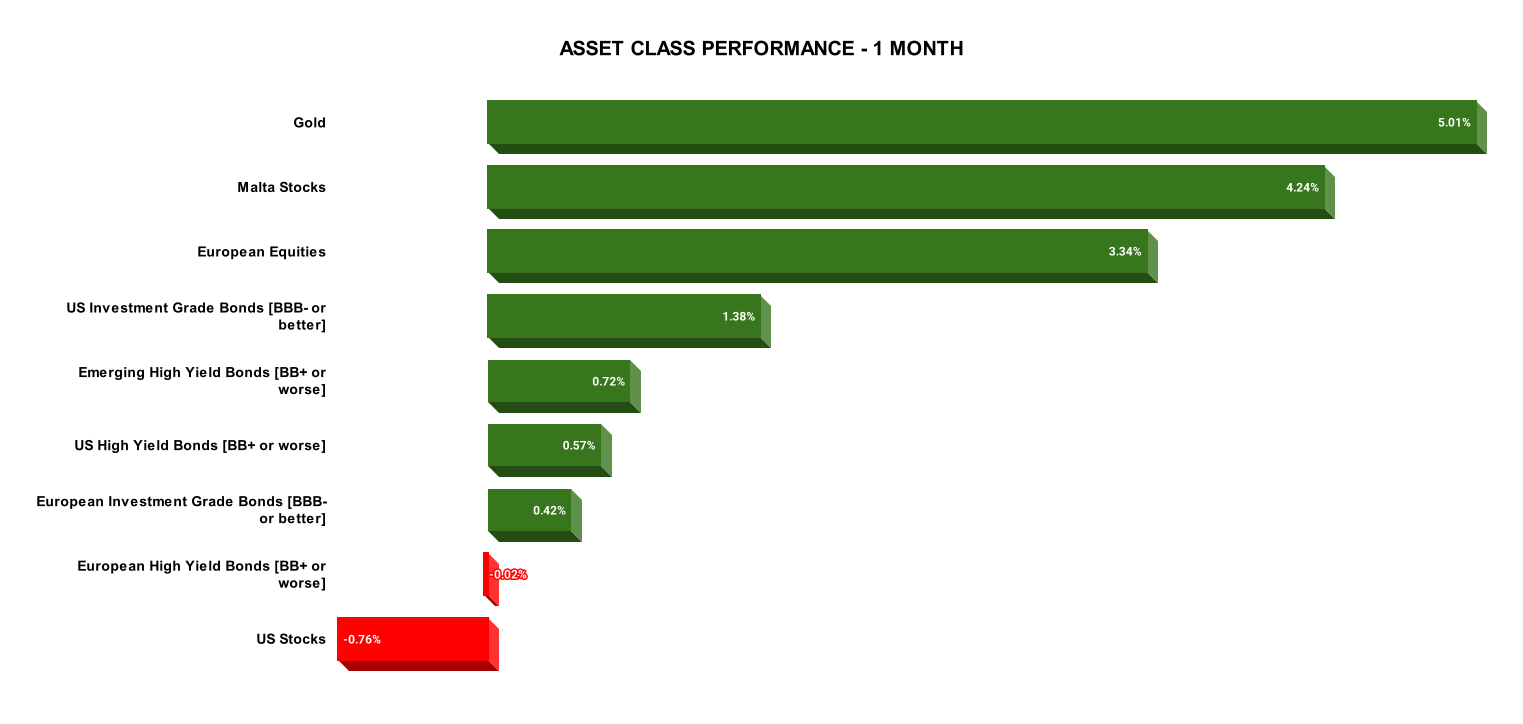
US equities were among the weaker performers over the month. A notable contributor to the decline was the technology sector, where the Magnificent 7 Index fell -7.28%, reflecting a correction among some of the large technology companies that had previously driven market momentum. Broader benchmarks also experienced modest weakness. The NASDAQ Composite declined -3.33%, the S&P 500 slipped -0.76%, and the Dow Jones Industrial Average managed only a marginal gain of 0.31%. Across different market capitalisation segments, returns were similarly restrained. The Russell 1000 fell -0.54%, while the Russell 3000 edged lower by -0.48%. Smaller companies performed slightly better, with the Russell 2000 posting a modest gain of 0.80%. Taken together, these movements suggest that US equity markets entered a phase of consolidation after a prolonged period of strong performance.
In contrast, European equity markets generally produced positive returns during the same period. The Euro Stoxx Index advanced 3.50%, while the Euro Stoxx 50 rose 3.34%. Major national benchmarks also recorded gains, with Germany’s DAX increasing 3.04%, France’s CAC 40 climbing 5.60%, and the Netherlands’ AEX Index rising 2.82%. Southern European markets also performed steadily, with Spain’s IBEX 35 gaining 2.70% and Portugal’s PSI Index rising 7.09%. Northern Europe experienced particularly strong momentum, with Sweden’s OMX Stockholm 30 advancing 6.55%. Across market capitalisation groups, performance was broadly constructive, with European mid-cap equities rising 4.71%, large caps gaining 3.94%, and small caps increasing 2.36%, pointing to a fairly widespread participation in the regional rally. In the United Kingdom, large multinational companies led market performance. The FTSE 100 increased 7.04%, comfortably outperforming the more domestically focused FTSE 250, which rose 2.30%. This disparity suggests that companies with greater international exposure benefitted more strongly from global economic conditions than those primarily reliant on the domestic UK economy.
Across the Asia-Pacific region, performance was particularly robust in certain markets. Taiwan recorded one of the strongest gains globally, with the Taiwan Stock Exchange Weighted Index rising 10.45%. Japan also enjoyed a strong month, with the Nikkei 225 advancing 10.42%. Elsewhere in the region, performance was more subdued. China’s CSI 300 edged up 0.17%, reflecting a modest recovery in mainland equities, while India’s Nifty 50 declined -0.44%. Indonesia also posted a slight loss, with its market falling -1.13%. Outside Asia, emerging markets produced mixed outcomes. Brazil’s Ibovespa Index rose 4.09%, supported by strength in commodity-related sectors, while South Africa’s FTSE/JSE Top40 Index increased 7.19%. Eastern European markets were more restrained following previous strong gains, with Romania rising 3.39% and Hungary declining -1.78%, suggesting that earlier market momentum had moderated. Canada also delivered a solid performance, as the S&P/TSX Composite Index gained 7.72%, benefiting from strength in energy and natural resource sectors.
FIXED INCOME MARKETS delivered modest but broadly positive performance during February. While gains were recorded across most bond segments, returns remained relatively moderate, reflecting a stable market environment characterised by gradual shifts in interest rate expectations and steady demand for high-quality debt instruments. Within sovereign bond markets, developed market government securities produced consistent gains. In the euro area, shorter-dated bonds generated modest returns, with 1–3 year maturities rising 0.29% and 3–5 year bonds gaining 0.71%. Performance strengthened further along the yield curve. The 7–10 year segment increased 1.61%, while 10–15 year bonds rose 2.23%, and 15+ year government bonds advanced 3.32%. These figures indicate that longer-dated European sovereign bonds delivered the strongest performance during the period. A comparable trend was evident in the United States Treasury market, where returns improved with increasing maturity. Treasuries in the 1–5 year segment gained 0.79%, while 5–7 year bonds rose 1.89% and 7–10 year maturities advanced 2.50%. The strongest returns occurred at the longer end of the curve, where 15+ year Treasuries increased 4.20%, highlighting the benefits of longer-duration exposure during the month.
The United Kingdom gilt market also experienced positive performance across most maturities. Bonds in the 5–7 year maturity range rose 1.17%, while 7–10 year gilts increased 2.43%. The longest-dated segment performed particularly well, with the 15+ year gilt index rising 4.40%, suggesting that investors were positioning for the possibility of lower yields or easing monetary conditions. Corporate credit markets also generated positive returns. Global investment-grade corporate bonds delivered a gain of 1.52%, while US corporate bonds rose 1.29%. In the UK, sterling-denominated investment-grade credit also performed steadily, with the AA-rated sterling corporate index increasing 1.29%. Emerging market investment-grade debt also benefited from investor demand, with euro-denominated securities gaining 2.27% and US-dollar-denominated investment-grade bonds rising 1.50%.
Returns within the high-yield market were more modest and varied across regions. Global high-yield bonds recorded a small gain of 0.04%, while US high-yield increased 0.16% and the broader US corporate high-yield market rose 0.19%. European high-yield bonds delivered slightly stronger results, with the overall market rising 0.12%, single-B rated bonds increasing 0.14%, and BB-rated bonds gaining 0.46%. Sterling high-yield bonds also advanced 0.63%. However, the lowest-rated European segment declined -1.08%, suggesting continued investor caution towards weaker credits. Emerging market high-yield debt recorded somewhat stronger gains, with the segment rising 0.72%, indicating that investors remained willing to allocate capital to higher-yielding assets despite the relatively subdued overall performance of credit markets.
The world’s major central banks maintained a broadly cautious approach to monetary policy as they assessed the interaction between moderating inflation and rising geopolitical risks. Policymakers appeared reluctant to make significant policy adjustments while uncertainty remained elevated. The European Central Bank (ECB) opted to keep its key policy rates unchanged at its February meeting. Officials emphasised that further confirmation was required before concluding that inflation was sustainably returning to the 2% medium-term target. Although the euro area economy continued to demonstrate resilience in certain areas, policymakers acknowledged that global economic conditions remained uncertain. The ECB therefore signalled that it would avoid signalling any immediate policy easing until the potential inflationary consequences of geopolitical developments became clearer.
In the United States, the Federal Reserve adopted a similarly cautious stance. Interest rates were left unchanged while policymakers continued to monitor incoming economic data, particularly developments in inflation and labour market conditions. Attention within financial markets also focused on discussions surrounding the appointment of a new Federal Reserve Chair, highlighting the importance of maintaining central bank independence in an increasingly politicised environment. Investors also debated the likely timing of future interest rate reductions as economic indicators began to show signs of softer employment growth alongside mixed inflation trends. At the same time, geopolitical developments remained a key driver of market sentiment. Tensions in the Middle East intensified during the month, raising concerns about a potential escalation involving Iran. These developments contributed to increased volatility across energy, currency and equity markets. In particular, the possibility of disruptions around the Strait of Hormuz, a vital route for global oil shipments, heightened concerns about energy supply security.
Energy security consequently became a central theme in international policy discussions. At events such as the Munich Security Conference, policymakers highlighted the increasing link between energy infrastructure and national security considerations. Governments in Europe and North America also discussed strategies to strengthen energy resilience and reduce reliance on vulnerable supply chains following earlier disruptions to global energy markets. Meanwhile, global economic data pointed to modest but uneven growth across regions. Business activity surveys suggested that global economic momentum improved slightly at the beginning of the year, although overall expansion remained below long-term historical averages. Manufacturing activity and international trade showed signs of stabilising following the slowdown observed in late 2025, yet business confidence remained fragile given ongoing geopolitical tensions and policy uncertainty. Another important theme emerging during the period was the gradual fragmentation of the global economic landscape. Increasing geopolitical competition, shifting alliances and rising economic nationalism are reshaping global trade and investment patterns. Governments are increasingly prioritising strategic industries, diversifying supply chains and reducing dependence on geopolitical rivals. As a result, the structure of global economic cooperation, capital flows and international trade relationships is continuing to evolve.
Important Information:
This article was prepared by Jesmar Halliday, CFA, Portfolio Manager at MZ Investments and is intended solely for information purposes. The contents of this article should not be construed as investment, legal or tax advice, or as a recommendation to buy, sell, or hold any securities, investment strategy or market sector. The information contained in this article was obtained from sources believed to be reliable and has not been verified independently. MZ Investments, its directors and employees give no warranties of any kind, expressed or implied, with regard to the accuracy, correctness or completeness of this article and accepts no responsibility or liability for any loss or damages arising out of the use of all or any part of this article. MZ Investments is under no obligation to update or keep current the information contained therein. All investments involve risk. The value of investments may go down as well as up and investors may not get back the amount originally invested. Investors are urged to seek professional advice before making investment decisions.
M.Z. Investment Services Limited (MZISL) of 63, MZ House, St Rita Street Rabat, Malta RBT 1523, is regulated by the MFSA and licensed to conduct investment services business in terms of the Investment Services Act Cap. 370 of the Laws of Malta. MZISL is a member of the Malta Stock Exchange and enrolled under the Insurance Distribution Act, Cap. 487 of the Laws of Malta, as a Tied Insurance Intermediary for MAPFRE MSV Life p.l.c. (MMSV). MMSV (C-15722) is authorised by the MFSA to carry on long-term business under the Insurance Business Act, Cap 403 of the Laws of Malta. MMSV is regulated by the MFSA.