

MONTHLY MARKET UPDATE
October 2026
Author: Jesmar Halliday, CFA
STOCK MARKETS experienced a challenging October, with performance diverging considerably across regions. Asian equities were particularly weak, while European markets delivered mixed returns and US equities recorded relatively modest declines. The month was characterised by renewed investor caution, concerns surrounding elevated technology valuations and uncertainty over the outlook for global economic growth.
Asian equity markets suffered some of the sharpest declines during the month. Indonesia’s Jakarta Composite Index fell by 16.60%, making it the weakest performer among the major indices considered, while Brazil’s Ibovespa declined by 9.88%. In Indonesia, concerns over the potential reclassification of the country’s equity market from emerging to frontier market status contributed to substantial selling pressure. In Brazil, political uncertainty surrounding the presidential election and concerns over the future direction of fiscal policy weighed on investor confidence. Chinese equities also came under considerable pressure, with the CSI 300 Index losing 8.35%, reflecting continued concerns over domestic economic momentum and investor confidence. China’s equity market continued to face pressure from subdued domestic demand and persistent weakness in the property sector, despite support from exports and industrial activity. Taiwan’s equity market declined by 5.69%, while Japan’s Nikkei 225 fell by 5.19%. India’s Nifty 50 proved considerably more resilient, gaining 1.95%, highlighting the divergence in performance across Asian markets.
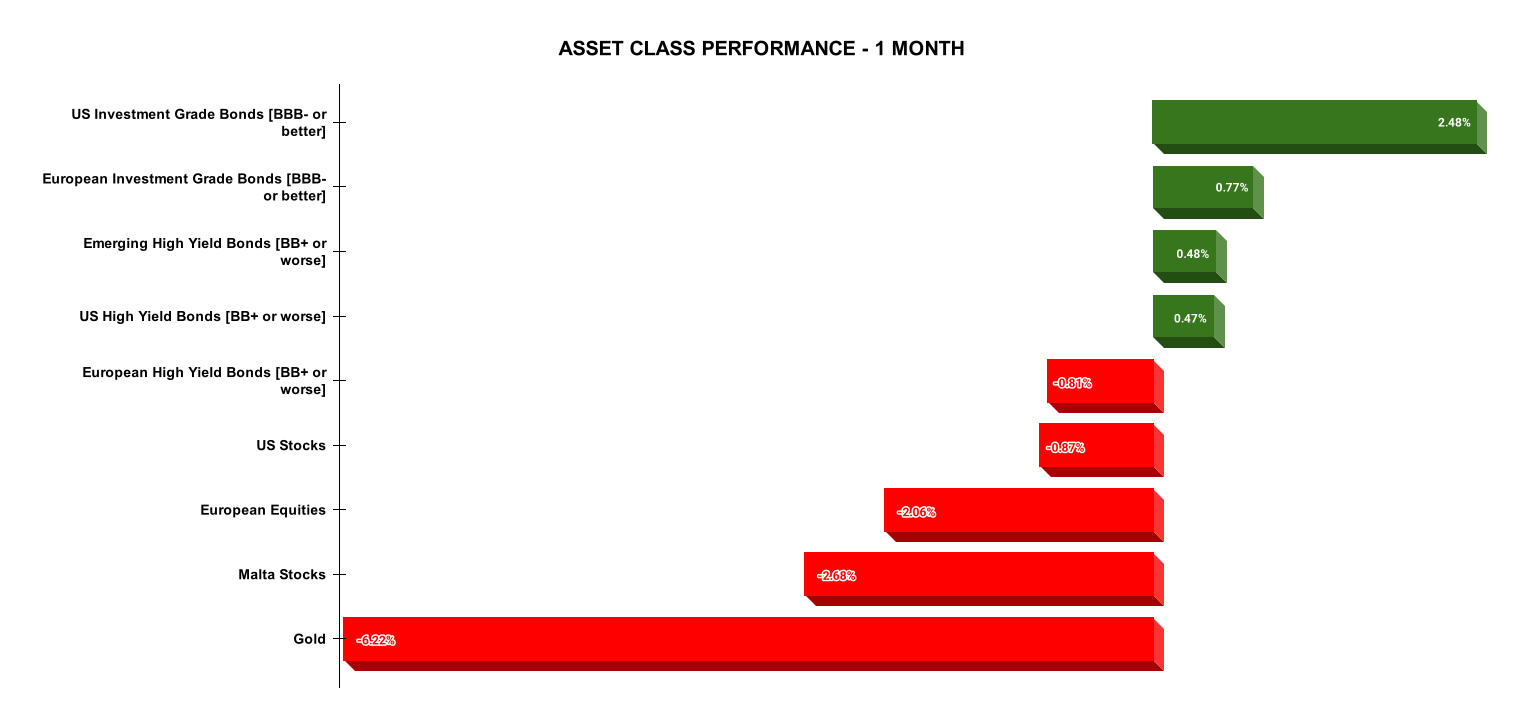
US equities also ended October in negative territory, although losses were generally more contained. The Nasdaq Composite declined by 5.28%, underperforming the broader S&P 500 Index, which fell by just 0.87%. The Magnificent Seven declined by 4.67% highlighting weakness among the large-cap technology companies that have been important drivers of US equity market performance. The Russell 1000 fell by 0.69%, while the Russell 3000 declined by 0.64%. In contrast, the Dow Jones Industrial Average advanced by 1.76%, as investors rotated away from growth-oriented technology companies towards broader sectors. Smaller companies also held up relatively well, with the Russell 2000 gaining 0.58%.
Several important developments contributed to the volatility experienced during October. In the United States, investor attention increasingly shifted towards the sustainability of artificial intelligence-related investment, particularly the substantial capital expenditure commitments undertaken by major technology companies. Concerns over the returns generated by these investments, together with pressure on free cash flow, contributed to selling across technology and semiconductor shares. The weakness was particularly evident towards the end of the month as quarterly earnings announcements renewed scrutiny of AI spending. However, the sell-off was not uniform, with energy, healthcare, utilities and consumer staples benefiting from a rotation towards more defensive areas of the market.
European equity markets delivered a mixed performance, with considerable differences between individual countries and sectors. The Euro Stoxx 50 declined by 2.06%, while the broader Euro Stoxx Index fell by 1.50%. Portugal’s PSI 20 lost 4.04%, Italy’s FTSE MIB declined by 3.64% and Spain’s IBEX 35 fell by 3.53%. By contrast, Germany’s DAX gained 2.46%, outperforming several of its European counterparts, while France’s CAC 40 edged higher by 0.15%. The UK’s FTSE 100 advanced by 1.29%, while the FTSE 250 was broadly unchanged, declining by just 0.08%. These differences highlight the importance of country and sector exposures, particularly during periods when market leadership becomes increasingly concentrated. October’s performance reflected a notable divergence between technology-heavy markets and those with greater exposure to traditional industries, smaller companies and selected domestic growth opportunities. The weakness in US technology shares and several major Asian markets contrasted with the relative resilience of the Dow Jones, European mid-cap equities and certain Eastern European exchanges. The variation in returns reinforced the importance of geographic diversification, sector allocation and valuation discipline in an environment where investor sentiment remained sensitive to changes in growth expectations and financial conditions.
The broader message from October was one of changing market leadership rather than a uniform deterioration in global equity markets. While technology-heavy indices and several emerging markets experienced substantial corrections, more defensive sectors and selected European markets delivered positive returns. Corporate earnings remained relatively resilient, although investors became increasingly selective in their assessment of valuations, earnings quality and capital expenditure requirements. Looking ahead, the sustainability of AI-related investment, the direction of monetary policy, geopolitical developments and the resilience of corporate profitability are likely to remain central to equity market performance.
FIXED INCOME MARKETS delivered broadly positive returns during October 2026, with government bonds outperforming corporate credit as investors increasingly favoured higher-quality assets amid uncertainty surrounding economic growth and weakness across equity markets. Longer-duration government bonds were particularly strong, benefiting from declining sovereign yields and renewed demand for defensive assets. In contrast, European high yield credit experienced a challenging month, reflecting greater investor caution towards lower-rated issuers and refinancing risks.
Government bonds recorded positive returns across major developed markets, with longer maturities significantly outperforming shorter-dated securities. The 15+ Year US Treasury Index gained 5.20%, compared with 3.05% for the 7–10 year segment in the treasury curve. Similarly, long-dated euro government bonds advanced by 2.59%, while UK gilts with maturities exceeding 15 years gained 3.70%. This performance reflected the greater sensitivity of longer-duration securities to falling yields, supported by changing monetary policy expectations and demand for safe-haven investments. Investment grade corporate bonds also performed well, benefiting from declining government bond yields despite some widening in credit spreads. US investment grade corporate bonds gained 2.16%, while euro and sterling investment grade securities returned 0.76% and 0.81%, respectively. Global investment grade corporate bonds advanced by 3.06%.
High yield credit experienced greater pressure, particularly in Europe, where concerns surrounding economic growth, corporate leverage and refinancing requirements weighed on sentiment. European high yield declined by 0.81%, with the lower-rated CCC and below segment falling sharply by 6.97%, compared with a more modest decline of 0.34% for BB-rated securities. Conversely, US high yield proved more resilient, gaining 0.47%, while emerging market high yield advanced by 0.48%. Credit markets were influenced by uncertainty surrounding monetary policy, geopolitical tensions and increasing scrutiny of corporate borrowing requirements, particularly those associated with substantial artificial intelligence infrastructure investment. Political and fiscal concerns in parts of Europe also contributed to investor caution. These developments encouraged greater differentiation between issuers, with stronger balance sheets and higher credit quality generally attracting more favourable investor sentiment.
Important Information:
This article was prepared by Jesmar Halliday, CFA, Portfolio Manager at M.Z. Investment Services Limited (“MZ Investments”), and is intended solely for information purposes. The period under review is 30 September 2026 to 31 October 2026. Past performance is not a reliable indicator of future performance. Unless otherwise stated, all performance figures are expressed in local currency terms and reflect total returns, including dividends and other distributions reinvested, where applicable. Index movements are shown in the local currency of each index. Measured in euro, these movements may be higher or lower as a result of currency fluctuations.. The contents of this article should not be construed as investment, legal or tax advice, or as a recommendation to buy, sell or hold any securities, investment strategy or market sector. The information contained in this article was obtained from sources believed to be reliable but has not been independently verified. MZ Investments is under no obligation to update or keep current the information contained herein. All investments involve risk. The value of investments may fall as well as rise, and investors may not recover the amount originally invested. Investors are encouraged to seek independent professional advice before making investment decisions.
Regulatory Information:
M.Z. Investment Services Limited (MZISL), of 63, MZ House, St Rita Street, Rabat, Malta RBT 1523, is regulated by the Malta Financial Services Authority (MFSA) and licensed to conduct investment services business in terms of the Investment Services Act, Cap. 370 of the Laws of Malta. MZISL is a member of the Malta Stock Exchange and enrolled under the Insurance Distribution Act, Cap. 487 of the Laws of Malta, as a Tied Insurance Intermediary for Mapfre MSV Life p.l.c. Mapfre MSV Life p.l.c. (C-15722) is authorised by the MFSA to carry on long-term business under the Insurance Business Act. All entities are regulated by the MFSA.