

MONTHLY MARKET UPDATE
June 2026
Author: Jesmar Halliday, CFA
EQUITY MARKETS produced a mixed performance during June 2026, with investors balancing encouraging economic developments against ongoing geopolitical uncertainty. Market sentiment improved as concerns surrounding the conflict between Israel and Iran eased towards the latter part of the month, helping to reduce fears of a broader disruption to global energy supplies. At the same time, central banks continued to signal a gradual path towards lower interest rates, while resilient economic data in several major economies supported investor confidence. Nevertheless, gains remained uneven across regions as investors continued to differentiate between markets based on valuations, economic momentum and sector composition
The United States experienced a divergence between technology-related investments and the broader market. The MAG7 declined by 8.81%, making it one of the weakest-performing equity benchmarks during the month, as investors took profits following the sector’s exceptionally strong performance earlier in the year. The technology-heavy NASDAQ Composite also fell by 2.75%. In contrast, broader US indices proved more resilient, with the S&P 500 declining only 0.95%, while the Dow Jones Industrial Average gained 2.71%, reflecting a rotation towards more traditional sectors such as financials, industrials and healthcare. Smaller companies also outperformed, with the Russell 2000 advancing 3.74%, compared with a modest decline of 0.30% in the Russell 1000.
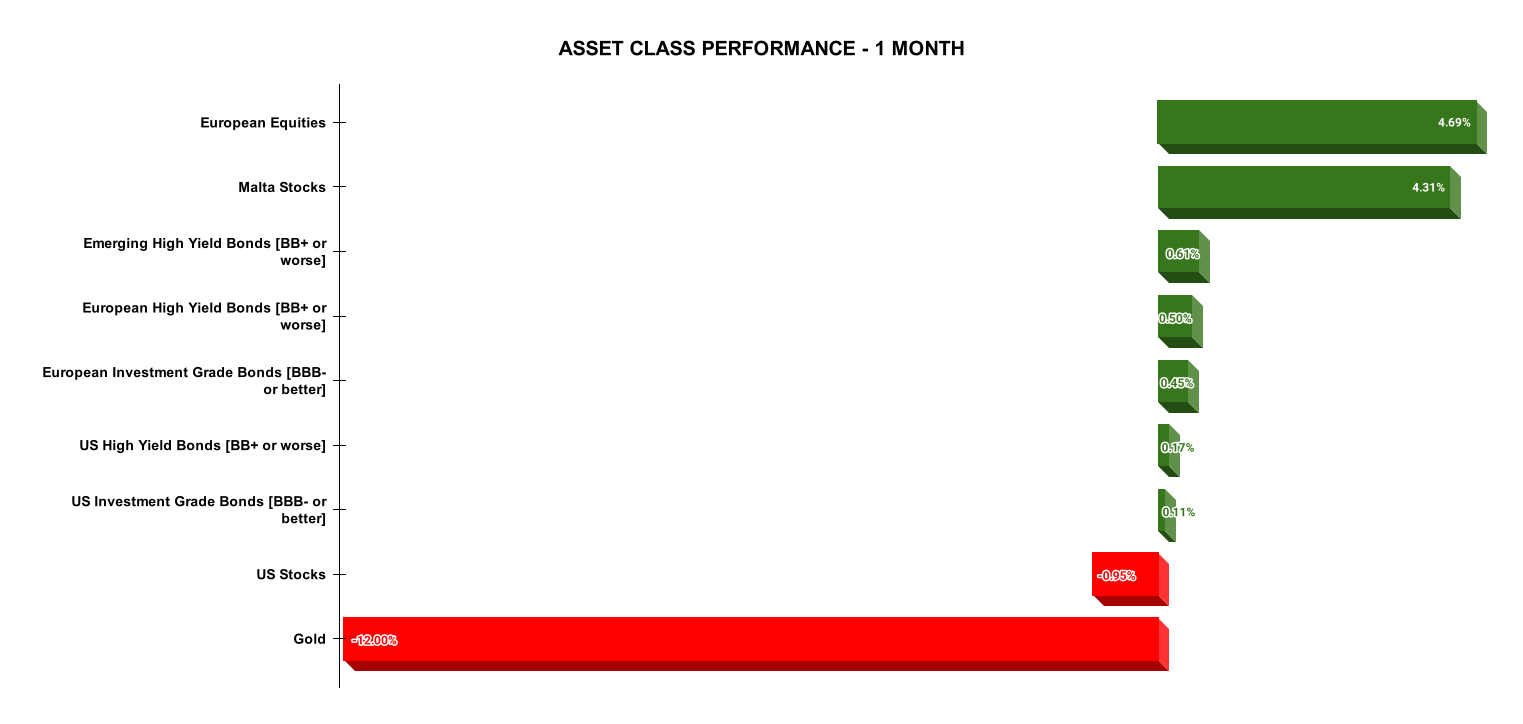
European equity markets generally delivered solid returns during June as easing inflationary pressures and expectations of further monetary policy support improved investor sentiment. The Euro STOXX 50 rose by 4.69%, while the broader EURO STOXX gained 3.74%. Strong performances were also recorded in Spain, where the IBEX 35 advanced 6.30%, Italy, with the FTSE MIB gaining 3.50%, France, where the CAC 40 increased 2.99%, and the Netherlands, where the AEX Index rose 4.40%. Germany’s DAX was comparatively subdued, declining 0.43%, reflecting continued concerns surrounding the country’s manufacturing sector. The UK’s FTSE 100 and FTSE 250 posted gains of 0.97% and 1.52% respectively, supported by stronger commodity prices and improved domestic sentiment.
Asian markets also delivered mixed results. Japan was among the strongest performers, with the Nikkei 225 rising 5.70%, supported by continued corporate governance reforms, shareholder-friendly initiatives and a relatively weaker yen. Taiwan gained 3.51%, benefiting from continued strength in semiconductor-related industries despite weakness in some US technology stocks. Mainland China’s CSI 300 advanced 2.32% as authorities continued to introduce targeted measures aimed at supporting economic growth and the property sector. India’s Nifty 50 added 1.75%, reflecting continued confidence in the country’s long-term economic outlook, while Indonesia underperformed, with the Jakarta Stock Exchange Composite falling 6.95%, as investors reacted to domestic policy concerns and capital outflows.
Elsewhere, performance across emerging and frontier markets varied considerably. Romania delivered the strongest return among the indices monitored, with the Bucharest Stock Exchange rising 10.28%, supported by strong domestic investor demand and favourable corporate developments. Hungary also performed well, with the Budapest Stock Exchange gaining 3.92%, while Malta’s equity market advanced 4.31%. Portugal’s PSI rose 1.41%, Sweden’s OMX Stockholm 30 gained 2.08%, and Latvia’s OMX Riga edged 0.48% higher. Brazil’s Ibovespa declined 1.01%, reflecting weaker commodity prices during parts of the month and ongoing fiscal concerns, while Africa’s FTSE/JSE Top40 fell 4.54% amid pressure on mining shares and persistent domestic economic challenges.
FIXED INCOME MARKETS delivered broadly positive returns during June 2026 as investor sentiment improved following a reduction in geopolitical tensions and growing confidence that major central banks remained on course to gradually ease monetary policy over the coming quarters. While inflation remained above target in several developed economies, continued evidence of moderating price pressures and resilient economic growth supported demand for bonds. Government bond yields generally moved lower during the month, particularly at the longer end of the yield curve, allowing longer-duration bonds to outperform shorter-dated securities.
Within European government bonds, longer maturities generated the strongest returns as investors sought to price-in positive developments on the US-Iran front that reduced inflationary risks. Despite the normalisation in relations between the US and Iran, the ECB still increased rates during the month as scenarios on the impact to the Eurozone economy were mostly inflationary across most measures as per Ms. Lagarde view. Euro government bonds with maturities of 15 years or longer returned 0.64%, matching the performance of the 10–15 year segment, while 7–10 year bonds gained 0.48% and 5–7 year bonds rose 0.36%. Shorter-dated securities delivered more modest gains, with 3–5 year bonds returning 0.26% and 1–3 year bonds increasing by 0.20%, reflecting the relatively limited scope for further declines in short-term interest rates. United States Treasury markets also produced positive returns, although performance strengthened as duration increased. Bonds with maturities of 15 years or longer gained 1.04%, significantly outperforming shorter-dated Treasuries, where 1–5 year bonds rose only 0.06%, 5–7 year bonds advanced 0.13%, and 7–10 year maturities returned 0.26%. The stronger performance at the long end reflected declining long-term yields as investors became increasingly confident that inflation would continue to moderate without materially weakening economic activity. UK government bonds also recorded solid gains across the maturity spectrum, with long-dated gilts returning 0.89%, 7–10 year gilts rising 0.70%, 5–7 year gilts gaining 0.45%, and shorter maturities returning 0.49%.
Corporate bond markets continued to benefit from relatively stable credit conditions and healthy corporate fundamentals. Euro investment grade corporate bonds gained 0.44%, while the broader global investment grade corporate bond market delivered a stronger return of 1.63%. Emerging market investment grade bonds also performed well, returning 2.31% in euro terms reflecting renewed investor appetite for higher-yielding quality credit as volatility eased.
High yield credit remained resilient throughout the month despite lingering geopolitical uncertainty. European high yield bonds returned 0.55%, with the single-B segment outperforming at 0.80% and the lower-rated CCC segment generating an impressive 1.17%, illustrating investors’ increasing willingness to accept greater credit risk. The broader European high yield market also advanced 0.54%, while global high yield bonds hedged into euros gained 0.48%. In the United States, high yield bonds delivered a more modest return of 0.25%, while the wider US corporate high yield market rose 0.27%. Emerging market high yield debt also performed strongly, returning 1.10%, supported by improving risk sentiment. The only notable weakness came from the unhedged global high yield market, which declined 0.13%, largely reflecting currency movements rather than underlying credit fundamentals.
Across other regions, Indian government bonds stood out with a return of 2.68%, benefiting from favourable domestic inflation dynamics and continued investor confidence in the country’s economic outlook. Chinese government and corporate bond markets posted modest gains of 0.16% and 0.14% respectively, as policymakers continued to implement targeted measures to support economic growth without resorting to aggressive monetary easing. Meanwhile, the broad global aggregate bond index fell 0.71% in unhedged US dollar terms but recorded a positive return of 0.19% when measured in local currencies, highlighting the significant influence that exchange rate movements had on global bond investors during the month.
June 2026 was characterised by improving investor confidence as easing geopolitical tensions, moderating inflation and growing expectations of further monetary policy easing provided a more supportive backdrop for financial markets. While regional and sector-specific performance remained uneven, the overall environment became increasingly constructive, with investors displaying a greater willingness to move back into risk assets as fears of a significant global economic slowdown continued to subside.
Equity markets benefited from this improvement in sentiment, although leadership broadened beyond the large US technology companies that had driven returns earlier in the year. European equities, smaller companies and several emerging markets outperformed, reflecting improving economic expectations and attractive relative valuations. Within fixed income, declining government bond yields supported positive returns across most segments, with longer-duration government bonds and lower-rated corporate credit delivering the strongest performance as investors sought to position for a gradual easing cycle by major central banks.
Looking ahead, markets are likely to remain focused on incoming inflation data, the pace of interest rate reductions by the major central banks, corporate earnings and ongoing geopolitical developments. Although short-term volatility cannot be ruled out, the combination of resilient economic activity, easing monetary policy expectations and stable corporate fundamentals continues to provide a constructive medium-term outlook for both equity and fixed income markets. Prudent diversification across asset classes and regions therefore remains key to navigating the evolving investment landscape.
Important Information:
This article was prepared by Jesmar Halliday, CFA, Portfolio Manager at MZ Investments and is intended solely for information purposes. The contents of this article should not be construed as investment, legal or tax advice, or as a recommendation to buy, sell, or hold any securities, investment strategy or market sector. The information contained in this article was obtained from sources believed to be reliable and has not been verified independently. MZ Investments, its directors and employees give no warranties of any kind, expressed or implied, with regard to the accuracy, correctness or completeness of this article and accepts no responsibility or liability for any loss or damages arising out of the use of all or any part of this article. MZ Investments is under no obligation to update or keep current the information contained therein. All investments involve risk. The value of investments may go down as well as up and investors may not get back the amount originally invested. Investors are urged to seek professional advice before making investment decisions.
M.Z. Investment Services Limited (MZISL) of 63, MZ House, St Rita Street Rabat, Malta RBT 1523, is regulated by the MFSA and licensed to conduct investment services business in terms of the Investment Services Act Cap. 370 of the Laws of Malta. MZISL is a member of the Malta Stock Exchange and enrolled under the Insurance Distribution Act, Cap. 487 of the Laws of Malta, as a Tied Insurance Intermediary for MAPFRE MSV Life p.l.c. (MMSV). MMSV (C-15722) is authorised by the MFSA to carry on long-term business under the Insurance Business Act, Cap 403 of the Laws of Malta. MMSV is regulated by the MFSA.