
MONTHLY MARKET UPDATE
April 2026
Author: Jesmar Halliday, CFA
EQUITY MARKETS globally recorded a strong and broadly positive month over the period under review, with gains largely concentrated in developed markets and higher-growth areas of the market. This came on the back of encouraging signs coming from the middle east as the ceasefire came into effect during the month between the US and Iran. US equities remained at the forefront of this upward move, driving overall performance. The S&P 500 rose by 10.49%, supported by widespread participation across the market spectrum, as evidenced by advances in the Russell 2000 (+12.29%), Russell 1000 (+10.10%) and Russell 3000 (+10.21%). Growth-led segments once again dominated returns, with the NASDAQ Composite climbing 15.32% and the Bloomberg Magnificent 7 index increasing by 14.88%, reflecting sustained demand for large-cap technology and innovation-focused companies.
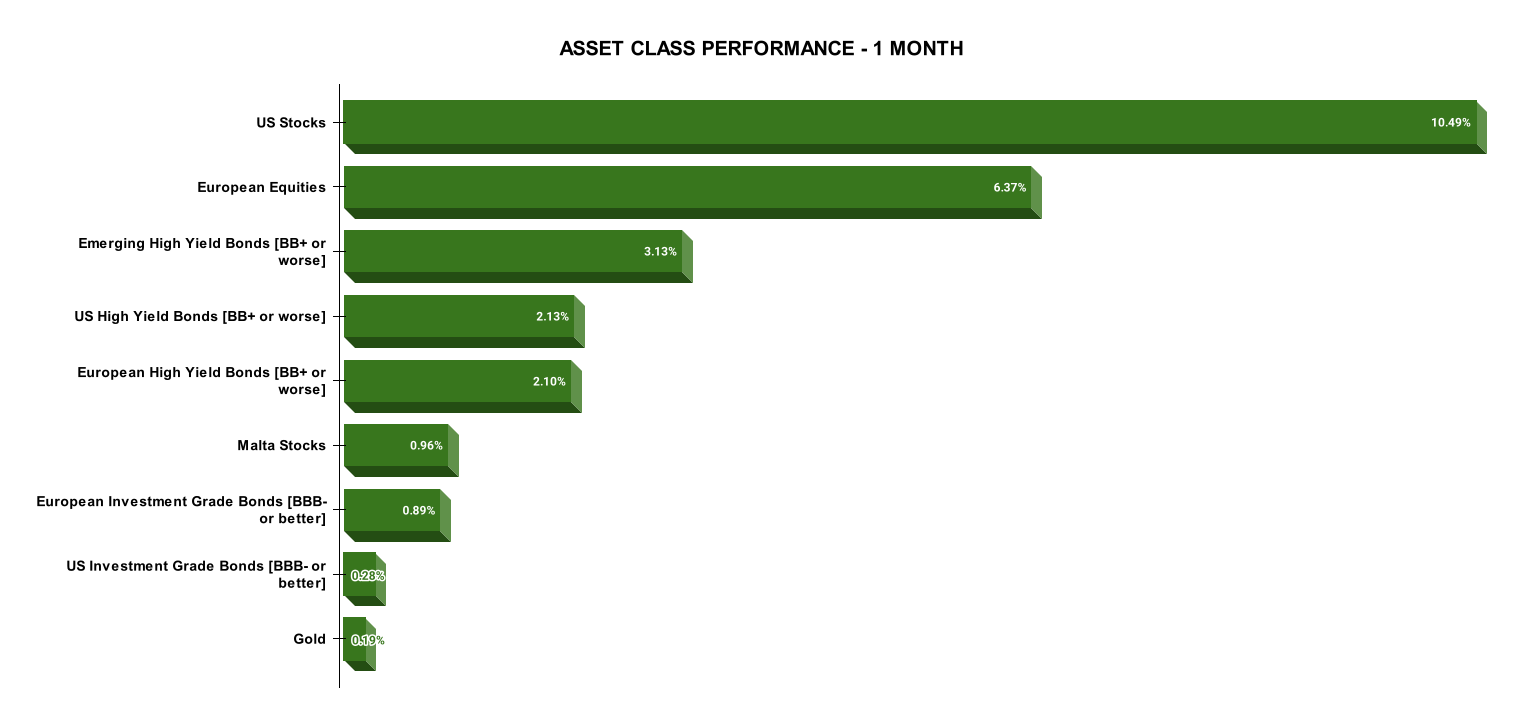
In Europe, equities also moved higher, although the pace of gains was more moderate relative to the US. Leading benchmarks such as the DAX (+7.11%), CAC 40 (+4.44%) and FTSE 100 (+2.28%) all delivered positive outcomes, while regional indices including the EURO STOXX 50 (+6.37%) and EURO STOXX Index (+6.56%) confirmed the constructive backdrop. Within the region, smaller companies displayed relative strength, with the MSCI Europe Mid Cap index rising by 4.93% and the MSCI Europe Small Cap index advancing by 7.44%, pointing to a gradual improvement in confidence towards domestic economic prospects. Peripheral markets stood out, with Italy’s FTSE MIB gaining 9.56%, Spain’s IBEX 35 increasing by 5.48%, and Hungary’s Budapest index rising by 10.22%.
Asian markets presented a more varied picture, though the overall direction remained positive. Japan delivered particularly strong performance, with the Nikkei 225 surging by 16.10%. Taiwan emerged as the standout performer globally, rallying by 22.72%, underpinned by continued strength in export-oriented and semiconductor sectors. China’s CSI 300 rose by 8.15%, suggesting some stabilisation in investor confidence, while India’s Nifty 50 advanced by 7.49%, maintaining its positive trajectory. Nonetheless, performance across emerging markets was not uniform, with Indonesia (-0.68%), Brazil (-0.08%) and Latvia (-0.18%) registering slight declines, reflecting more localised challenges.
FIXED INCOME MARKETS displayed a more differentiated performance profile, with a clear divide between sovereign bonds and credit-oriented assets. Government bonds, particularly those with longer maturities, came under pressure as yields remained elevated. UK gilts experienced notable weakness, with returns of -1.82% in the 15+ year segment and -0.23% in the 7–10 year range. A similar pattern was observed in US Treasuries, where the 15+ year segment declined by 0.69% and the 7–10 year range edged lower by 0.11%, reflecting ongoing sensitivity to interest rate expectations.
Shorter-duration bonds, however, showed greater resilience. US Treasuries in the 1–5 year maturity bracket recorded a modest gain of 0.15%, while UK gilts in the 3–5 year segment rose by 0.17%. Euro area government bonds followed a comparable trend, with returns of 0.46% in the 5–7 year segment and 0.49% in the 7–10 year range, indicating a somewhat more stable rate environment within the region. Investment grade credit produced mixed outcomes but remained broadly stable overall. The Bloomberg Global Aggregate Corporate index declined slightly by 0.52%, while US corporate bonds posted a positive return of 0.45%. Euro-denominated corporate bonds performed more favourably, gaining 0.94%, suggesting that credit spreads remained supportive despite the backdrop of higher yields. Emerging market debt was among the better-performing areas within fixed income. Indian government bonds rose by 0.81%, while Chinese government and corporate bonds gained 0.53% and 0.32% respectively. Broader emerging market investment grade credit delivered a stronger return of 1.42%, reflecting continued demand for yield-enhancing opportunities beyond developed markets. High yield credit stood out as the top-performing segment, highlighting a clear preference for risk within fixed income. US high yield generated a return of 1.70%, while European high yield delivered between 1.62% and 1.92%. Global high yield returned 2.06% on a hedged basis and 2.27% unhedged, with lower-rated segments, including CCC and similar categories, reaching gains of up to 3.66%. Emerging market high yield also performed strongly at 3.34%, underscoring investors’ willingness to move further along the credit spectrum.
Monetary policy across major economies remained characterised by caution, with central banks continuing to rely heavily on incoming data to guide decisions. The European Central Bank signalled a gradual progression towards a less restrictive stance, with increasing discussion around the possibility of easing later in the year, contingent on sustained progress in reducing inflation. While there was growing confidence that price pressures were easing, particular attention remained on wage developments and services inflation. In the United States, the Federal Reserve maintained a restrained and patient approach. Although inflation trends showed further improvement, they remained above the target level, leading policymakers to avoid providing firm guidance on the timing of rate cuts. Market expectations shifted throughout the period, influenced by economic data that pointed to ongoing strength in employment and consumer spending, reinforcing the perception that interest rates may remain elevated for longer.
The Bank of Japan continued to attract significant attention following earlier policy adjustments. The focus remained on how the central bank would manage the shift away from its historically accommodative stance. While changes were measured, there was a clear move towards a more adaptable policy framework, with emphasis placed on the durability of inflation and wage growth trends as Japan transitions towards a more normalised monetary setting. Geopolitical factors remained a consistent influence on market sentiment, with ongoing tensions contributing to intermittent volatility, particularly within energy markets. Although no major escalation materially disrupted global financial conditions, uncertainty persisted, keeping investors alert to potential risks to supply chains and commodity flows. From a macroeconomic standpoint, global growth remained uneven yet broadly resilient. The United States continued to show solid economic performance, supported by consumer activity and a strong labour market, although some leading indicators pointed towards a gradual moderation. In Europe, there were early signs of stabilisation following a softer period, with improving sentiment suggesting that economic conditions may be bottoming out, albeit at relatively subdued levels of growth. Across Asia, economic trends were mixed. China showed tentative signs of improvement, aided by targeted policy interventions designed to support domestic demand and the property sector, though longer-term structural challenges remained. Japan, on the other hand, benefited from stronger corporate performance and supportive financial conditions, contributing positively to both economic activity and equity market returns.
Important Information:
This article was prepared by Jesmar Halliday, CFA, Portfolio Manager at MZ Investments and is intended solely for information purposes. The contents of this article should not be construed as investment, legal or tax advice, or as a recommendation to buy, sell, or hold any securities, investment strategy or market sector. The information contained in this article was obtained from sources believed to be reliable and has not been verified independently. MZ Investments, its directors and employees give no warranties of any kind, expressed or implied, with regard to the accuracy, correctness or completeness of this article and accepts no responsibility or liability for any loss or damages arising out of the use of all or any part of this article. MZ Investments is under no obligation to update or keep current the information contained therein. All investments involve risk. The value of investments may go down as well as up and investors may not get back the amount originally invested. Investors are urged to seek professional advice before making investment decisions.
M.Z. Investment Services Limited (MZISL) of 63, MZ House, St Rita Street Rabat, Malta RBT 1523, is regulated by the MFSA and licensed to conduct investment services business in terms of the Investment Services Act Cap. 370 of the Laws of Malta. MZISL is a member of the Malta Stock Exchange and enrolled under the Insurance Distribution Act, Cap. 487 of the Laws of Malta, as a Tied Insurance Intermediary for MAPFRE MSV Life p.l.c. (MMSV). MMSV (C-15722) is authorised by the MFSA to carry on long-term business under the Insurance Business Act, Cap 403 of the Laws of Malta. MMSV is regulated by the MFSA.