
MONTHLY MARKET UPDATE
May 2026
Author: Jesmar Halliday, CFA
EQUITY MARKETS delivered a broadly positive performance over the month, although returns varied significantly across regions. The strongest gains were concentrated in Asia and the United States, reflecting improved investor sentiment towards technology-related sectors and a more constructive outlook for global growth. Conversely, a number of emerging and frontier markets experienced notable weakness. Taiwan was the standout performer, advancing 14.92% (led by TSMC), supported by continued strength in semiconductor and artificial intelligence-related companies. Japan also recorded an impressive gain of 11.88%, benefiting from improving corporate earnings expectations and a relatively supportive domestic backdrop. In the United States, technology-led indices continued to outperform, with the NASDAQ rising 8.43% and the Mag 7 gaining 6.64%. Broader market participation was also evident, with the S&P 500 returning 5.26%, the Russell 1000 advancing 5.10%, and the Russell 3000 gaining 5.07%. Small-cap stocks also participated in the rally, with the Russell 2000 increasing 4.37%.
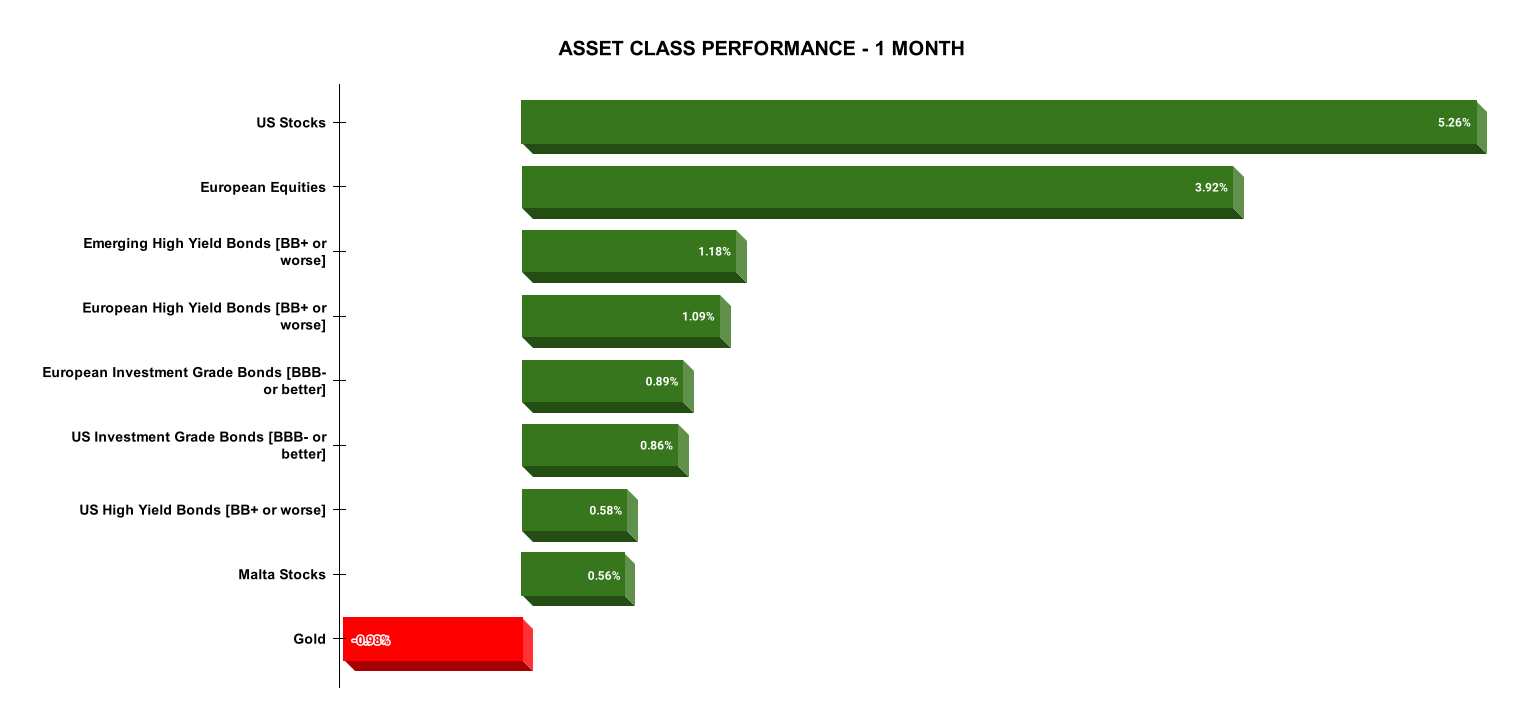
European equities delivered solid returns, although generally lagging the strongest-performing regions. Italy was among the best performers in Europe, with the FTSE MIB rising 5.29%, while the broader Euro Stoxx gained 4.22% and the Euro Stoxx 50 advanced 3.92%. Germany’s DAX increased 3.34%, Spain’s IBEX 35 returned 3.36%, and France’s CAC 40 gained 2.36%. Notably, European smaller companies outperformed larger capitalisation stocks, with the MSCI Europe Small Cap rising 4.05% compared with a 3.40% gain for the MSCI Europe Large Cap, suggesting improving confidence in the domestic economic outlook. The United Kingdom also posted respectable gains, with the FTSE 250 rising 4.59% and the FTSE 100 advancing 0.72%. The stronger performance of mid-cap stocks relative to large-cap constituents indicates that investors favoured more domestically exposed businesses over multinational exporters.
Performance across emerging markets was mixed. China recovered some ground, with the Shanghai Shenzhen CSI 300 Index gaining 1.94%, while India was broadly flat, declining 1.65%. More significant weakness was recorded in several other markets, including Brazil (-7.22%) and Indonesia (-11.24%), reflecting investor concerns surrounding economic growth prospects, currency movements and capital flows. Portugal also ended the month slightly lower, with the PSI Index declining 0.35%.
FIXED INCOME MARKETS delivered modestly positive returns over the month, with the strongest performance generally coming from longer-duration government bonds. The decline in bond yields across several developed markets provided a supportive backdrop, allowing investors holding longer-dated securities to benefit from capital appreciation in addition to income generation. Within the euro area, sovereign bonds performed well across the maturity spectrum. Returns increased progressively with duration, highlighting the market’s preference for longer-dated assets during the period. The 15+ Year Euro Government returned 1.88%, outperforming the 10–15 Year segment (+1.77%), the 7–10 Year segment (+1.42%), and shorter maturities. The broader Eurozone Sovereign credit gained 1.09%, reflecting positive performance across core and peripheral government bond markets. Corporate bonds also generated positive returns, although generally lagging government bonds. The Euro Corporate bond market returned 0.94%, while the Global Aggregate Corporate bond market (EUR unhedged) gained 1.14%. Investment grade credit continued to benefit from stable credit fundamentals and investor demand for income, though the majority of returns were driven by carry rather than significant spread compression.
In the United Kingdom, gilts delivered some of the strongest returns within developed market fixed income. Long-dated bonds were particularly impressive, with the UK Gilt 15+ Year rising 3.36%. Mid-maturity gilts also performed well, returning 1.90% for the 7–10 year segment and 1.03% for the 3–5 year segment. The performance pattern once again reflected the favourable impact of falling yields on longer-duration securities. By contrast, United States Treasury markets were comparatively subdued. The 15+ Year US Treasury gained 0.51%, while shorter and intermediate maturities produced little movement, with the 5–7 Year bracket declining 0.10% and the 7–10 Year slipping 0.02%. Expectations for US interest rates remained relatively stable compared with developments in Europe and the United Kingdom. Emerging market debt produced positive, albeit mixed, results. The Emerging Markets Investment Grade bonds returned 0.41% in US dollar terms and 0.93% in euro terms, while local currency sovereign bonds in India gained 0.54%. Chinese government and corporate bonds delivered more muted returns of 0.44% and 0.33% respectively, reflecting a relatively stable domestic interest rate environment.
High yield credit continued to generate positive returns, supported by investor appetite for risk and the attraction of elevated carry. The strongest performance was recorded in lower-rated European issuers, with the CCC & Lower European High Yield Market advancing 2.21%. More broadly, the European High Yield Market returned 0.93%, while BB-rated European High Yield gained 1.04%. Global and US high yield markets produced more modest returns of approximately 0.49%, indicating that investors remained selective despite the generally constructive market environment.
The European Central Bank opted to leave interest rates unchanged at its April policy meeting, emphasising that while inflation was broadly evolving in line with previous expectations, risks to price stability had increased. At the same time, the ECB acknowledged growing downside risks to economic activity, reflecting softer demand conditions across parts of the euro area. Policymakers reiterated their commitment to returning inflation sustainably towards the 2% target while remaining highly data dependent. Recent market pricing on interest rates expectation are that the ECB shall raise rates by 25bps in its 11 June 2026 meeting.
In the United States, the Federal Reserve also maintained a restrictive policy stance. Throughout May, several Federal Reserve officials signalled increased concern that higher energy costs and supply disruptions could lead to more persistent inflationary pressures. As a result, market participants increasingly considered the possibility that the next move in interest rates could be upwards rather than downwards if inflation failed to moderate. Meanwhile, resilient labour market conditions and stronger-than-expected employment growth continued to provide support to the US economy. The Bank of Japan adopted a notably more hawkish tone during the month. Governor Kazuo Ueda highlighted the growing need to prevent imported inflation and energy-related price pressures from becoming entrenched within the domestic economy. This shift reinforced expectations that further policy normalisation could follow in the coming months as Japanese inflation remained above historical norms. Global economic and geopolitical developments during May 2026 continued to be dominated by the repercussions of the ongoing conflict in the Middle East. Disruptions to energy supplies and concerns surrounding shipping routes through the Strait of Hormuz remained key drivers of market volatility, contributing to higher oil prices and renewed inflationary pressures across many economies. These developments also placed additional strain on global supply chains, raising concerns over the outlook for both growth and trade.
Economic data released during the month painted a mixed picture. The euro area showed signs of weakening activity, with softer business surveys, declining new orders and mounting concerns over a potential contraction in economic output during the second quarter. Rising input costs and elevated inflation continued to weigh on both business confidence and consumer spending across the region. In contrast, the United States demonstrated greater economic resilience. Labour market conditions remained firm, with employment growth exceeding expectations and unemployment remaining relatively stable. Nevertheless, investors remained mindful that persistent inflationary pressures could prolong the period of restrictive monetary policy, potentially slowing economic activity later in the year. International trade continued to show resilience despite a more challenging backdrop. However, forward-looking indicators suggested that the pace of global trade growth was beginning to moderate as businesses adapted to geopolitical uncertainty, higher transport costs and evolving trade patterns. Demand linked to artificial intelligence and technology-related investment remained a notable source of support for global manufacturing activity. From a geopolitical perspective, markets closely monitored developments in both the Middle East and Eastern Europe. Ongoing diplomatic efforts aimed at advancing negotiations between Russia and Ukraine remained in focus, although uncertainty surrounding the timing and prospects of a lasting resolution persisted. At the same time, governments and businesses increasingly assessed the longer-term implications of geopolitical fragmentation, supply-chain diversification and strategic economic security.
Important Information:
This article was prepared by Jesmar Halliday, CFA, Portfolio Manager at MZ Investments and is intended solely for information purposes. The contents of this article should not be construed as investment, legal or tax advice, or as a recommendation to buy, sell, or hold any securities, investment strategy or market sector. The information contained in this article was obtained from sources believed to be reliable and has not been verified independently. MZ Investments, its directors and employees give no warranties of any kind, expressed or implied, with regard to the accuracy, correctness or completeness of this article and accepts no responsibility or liability for any loss or damages arising out of the use of all or any part of this article. MZ Investments is under no obligation to update or keep current the information contained therein. All investments involve risk. The value of investments may go down as well as up and investors may not get back the amount originally invested. Investors are urged to seek professional advice before making investment decisions.
M.Z. Investment Services Limited (MZISL) of 63, MZ House, St Rita Street Rabat, Malta RBT 1523, is regulated by the MFSA and licensed to conduct investment services business in terms of the Investment Services Act Cap. 370 of the Laws of Malta. MZISL is a member of the Malta Stock Exchange and enrolled under the Insurance Distribution Act, Cap. 487 of the Laws of Malta, as a Tied Insurance Intermediary for MAPFRE MSV Life p.l.c. (MMSV). MMSV (C-15722) is authorised by the MFSA to carry on long-term business under the Insurance Business Act, Cap 403 of the Laws of Malta. MMSV is regulated by the MFSA.